UCH Symposium Explores Intergenerational Connections, Strong Communities, Well Being
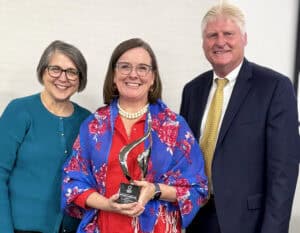
More than 150 people gathered in person and online Oct. 16, 2026, for the 11th Annual Symposium: Engaging Generations: Connecting Lives So All Can Thrive, a day-long event focused on the power of intergenerational relationships to build stronger, healthier communities.
Hosted by the Center for Abundant Aging at United Church Homes (UCH)—based in Marion, Ohio—the symposium was held at The Quest Conference Center in Columbus. It brought together aging services professionals, educators, faith leaders, researchers, students and community advocates from across Ohio and beyond to explore innovative ways to connect people of all ages.
The annual event featured presentations and discussions led by experts from The Ohio State University, United Church Homes, and other organizations working to advance intergenerational engagement and improve quality of life across generations.
“At United Church Homes, we believe abundant aging is made possible through connection, purpose, and belonging,” said Kenneth Young, president and CEO of United Church Homes. “The 11th Annual Symposium on Intergenerational Connections embodies our faith-inspired mission in action, bringing together leaders and advocates dedicated to strengthening relationships across generations and advancing the well-being of older adults. By creating understanding, collaboration, and shared experiences, we are helping people of all ages experience abundant life.”
Throughout the day, speakers shared research, best practices and real-world examples of programs that support connections between younger and older generations. Discussions highlighted the benefits of intergenerational engagement, including improved health and well-being, stronger communities and greater social connectedness.
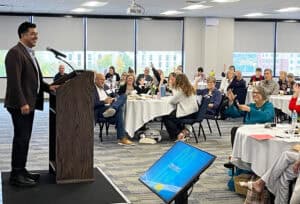
Young opened the day with a welcome, emphasizing that one foundation of a strong community are the relationships in and across generations. Two keynote addresses followed, first from Shannon Jarrott, Ph.D., professor of social work and director of faculty development in the College of Social Work at the Ohio State University; and then from Eddie Gonzalez, senior fellow at CoGenerate, a San Francisco-based non-profit organization that brings older and younger generations together to solve social problems, bridge divides, and combat ageism.
Jarrott discussed her own research in intergenerational social connections and community culture. “Building a culture of community aligns with my very favorite thing to so,” she said, which is bringing together people from all generations.
The three vital components of social connection, she said, are structure (number/variety of relationships and frequency of interaction), function (do the connections serve needs?), and quality (the positive and negative aspects of relationships and interactions). She noted that when forming an intentional group, intergenerational connections work best when five requirements are met:
- Support of authority figures, tradition, and policies
- Equal standing among members (each person is a teacher, each person learns)
- Cooperation
- Shared goals
- Opportunities for friendship (sharing social events between programs)
She added that her research work takes a community participatory approach, with the community as the unit of identity.
The second keynoter, Eddie Gonzalez, is a senior fellow at CoGenerate. He gave a talk titled “Reclaiming the Sacred Work of Bringing Generations Together.” Gonzalez said that part of his work included “recognizing faith communities as vital places where intergenerational life can flourish and where relationship across age become a meaningful spiritual practice.”
Gonzalez likened intergenerational—or “cogenerational” relationships in community to ecosystems. “We really need each other to make progress,” he said, and that the purpose of CoGenerate was to make “cogeneration” the new norm in society.
However, he said, many church communities don’t do intentional generational work. Who holds the power in faith and spiritual communities often is based on an assumption that seniority equals authority, which creates intergenerational conflict. Teen leaders, said Gonzalez, don’t wanted to be invited to the table only for “optics.” Echoing Jarrott’s earlier keynote, he noted that relationships falter when they’re one way, when reciprocity fails.
Gonzalez said the key is the relationship, noting that connection must come before collaboration. In intergenerational programming—as with other social programs—when relationships become transactional instead of relational, the program fails. He added that intergenerational connections may be inefficient, but they’re sustaining.
He closed with advice. “There are no universal models for cogenerational work,” he said. “Models help us imagine what’s possible, but it’s not a copy and paste.” Everything is adapted to the given situation, he said.
Finally, Gonzalez said, “Don’t give in to the temptation of just creating a new program in your location. Instead, look at what already exists and figure out how to do the work cogenerationally.”
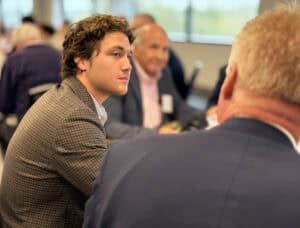
The symposium’s afternoon sessions were dedicated to four presentations:
- Generational Family Connections/Relationships: Raised by Her podcast, Ro Nita Hawes-Saunders, Donnica Hawes-Saunders
- Sages and Seekers: a program from the Connections Volunteer Center, Suzanne Pingry and Elaine Miller: Delaware Sages and Seekers Program coordinators
- Parkvue Pals, an intergenerational program: Brianna Rawlins, Bowling Green (Ohio) State University undergrad; and Jedd Rawlins, executive director of UCH’s Parkvue Community regional director of healthcare services at UCH
- Lifelong Learning Connections: OSU 60+ with Randy Marker, grandfather, and Oliver Yetman, grandson; Ken Young, moderator
“For those who have grown up in families with multiple generations, this idea of intergenerational connection seems easy and a ‘no brainer,’” said the Rev. Beth Long-Higgins, vice president of engagement and director, Center for Abundant Aging.
“I was struck by the fact that the three presenters who are engaged in research and practice of intergenerational programs and relationships began their presentations by talking about those connections in their own lives,” Long-Higgins added. “Another presenter who was sharing about their own familial relationships was completely surprised that this is whole field of study because it is just a natural part of their lived experience. And yet, we need the research to reinforce what previous generations have known—that we are all healthier, safer, more fulfilled, and connected when we have relationships with those younger and older than ourselves.”
The 12th Annual Symposium will be held Oct. 15, 2027, in Columbus.
Join Our Mailing LIst
"*" indicates required fields
Follow on Facebook
Problem displaying Facebook posts. Backup cache in use.
Click to show error